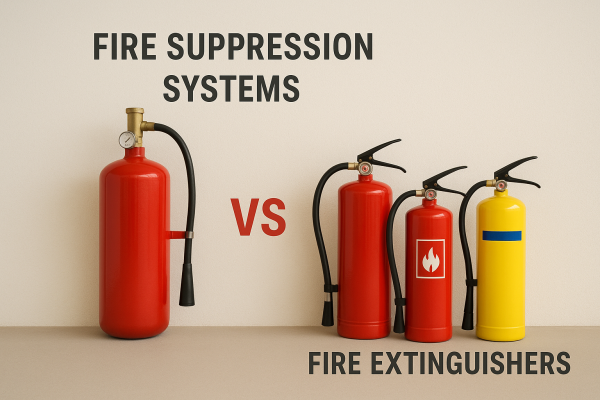
When it comes to fire safety, two terms are often used interchangeably — fire extinguishers and fire suppression systems.
While both play a vital role in protecting lives and property, they work in very different ways and are meant for different applications.
Understanding the difference between them helps you make smarter safety decisions for your workplace or facility.
What Is a Fire Extinguisher
A fire extinguisher is a portable device used to control small fires during their early stages.
They are designed for manual operation, meaning a trained individual must activate and direct the extinguisher toward the flames.
Common Types of Fire Extinguishers:
- ABC Dry Chemical: Suitable for ordinary combustibles, flammable liquids, and electrical fires.
- CO₂ Extinguishers: Ideal for electrical and electronic fires.
- Foam Extinguishers: Commonly used for liquid and oil fires.
- Water and Water Mist: Used for Class A fires (wood, paper, textiles).
Best for: Homes, offices, small commercial spaces, and vehicles.
What Is a Fire Suppression System?
A fire suppression system is an automated setup designed to detect and extinguish fires without human intervention.
It’s a fixed installation, often used in high-risk environments where quick action is crucial.
Types of Fire Suppression Systems:
- Clean Agent Systems (FM-200, Novec 1230): Leave no residue; ideal for server rooms or data centers.
- CO₂ Systems: Effective for industrial areas or engine rooms.
- Foam Systems: Used in fuel storage areas and aircraft hangars.
- Water Mist Systems: Environmentally friendly, used in hospitals and offices.
Best for: Industrial sites, server rooms, data centers, and critical infrastructure.
Key Differences Between Fire Suppression Systems and Extinguishers
| Feature | Fire Extinguishers | Fire Suppression Systems |
|---|---|---|
| Operation | Manual | Automatic |
| Coverage Area | Localized (small fires) | Entire room or facility |
| Refill Frequency | Annually or after use | Based on system checks |
| Response Time | Depends on user | Instant (automatic detection) |
| Maintenance | Simple | Requires professional service |
| Ideal For | Homes, offices | Industrial/commercial sites |
Which One Do You Need?
If your goal is quick response to small fires, a fire extinguisher is essential.
However, if you manage critical equipment or large facilities, a fire suppression system ensures round-the-clock protection — even when no one’s around.
In most cases, businesses should use both — extinguishers for immediate manual action and suppression systems for automated response.
FAQs
Q1: Can I replace a fire suppression system with multiple extinguishers?
No. Suppression systems are automated and designed for large areas; extinguishers cannot replicate their speed or coverage.
Q2: How often should suppression systems be serviced?
Every 6 months to ensure sensors, cylinders, and nozzles are functioning properly.
Q3: Are clean agent systems safe for humans?
Yes. Clean agents like Novec 1230 are non-toxic and safe for occupied spaces.
Need Expert Advice?
Still unsure which fire extinguisher suits your site best? Contact Safex Fire today for certified foam extinguishers tailored to your industrial needs.