Fire safety in India is not merely a matter of good practice; it is a stringent legal requirement governed by the National Building Code (NBC) and specific Bureau of Indian Standards (BIS). For facility managers, architects, and business owners, the question of “how many fire extinguishers do I need?” is often met with confusion. Under-equipping a facility leaves you vulnerable to catastrophic losses and severe legal liability, while over-equipping leads to unnecessary capital expenditure.
At Safex, we understand that fire safety is about precision. Since Safex established 1972, we have been helping Indian industries—from sprawling warehouses in Gujarat to high-tech campuses in Bengaluru—navigate the complexities of fire protection. This guide serves as a professional roadmap to calculating the correct number and type of fire extinguishers required for your premises, keeping you compliant with Indian regulatory frameworks.
The Regulatory Foundation: NBC 2016 and IS Standards
To determine the number of extinguishers required, one must first look at the National Building Code (NBC) 2016. Part 4 of the NBC 2016, which focuses on Fire and Life Safety, provides the framework for fire protection systems. However, for the specific technical specifications and the “how-to” of installation and selection, we turn to IS 2190:2010 (Code of practice for selection, installation, and maintenance of first-aid fire extinguishers).
The core principle of these standards is “hazard classification.” You cannot apply a one-size-fits-all approach to a carpeted office floor and a chemical storage facility. IS 2190 categorizes fire risks into Classes A, B, C, D, and K. Your fire extinguisher count is directly proportional to the floor area and the fire load of your facility.
For instance, in an ordinary hazard occupancy, the standard dictates that an extinguisher should be available within a travel distance of 15 to 20 meters. If your facility is large, simply having one or two units at the entrance is a violation of safety norms. Compliance officers often look for the “coverage area per extinguisher,” which is defined by the unit’s fire rating rather than its physical weight. A 6kg ABC powder-based extinguisher, manufactured in accordance with IS 15683:2018, provides a specific level of coverage that must be mapped against the total square footage of your floor plan.
Calculating Fire Load and Travel Distance
The primary metric for determining the quantity of fire extinguishers is the “Travel Distance.” According to IS 2190, no person should have to travel more than 15 meters to reach a fire extinguisher in an ordinary hazard occupancy. In high-hazard environments, such as server rooms or industrial paint shops, this distance is often reduced to 10 meters or less.
When you conduct your fire safety audit, start by marking your floor plan with these radii. If a specific corner of your warehouse is 25 meters away from the nearest extinguisher, you are non-compliant. This is where many facility managers fall short during fire department inspections. The penalty for non-compliance can range from heavy fines to the revocation of your No Objection Certificate (NOC), effectively shutting down operations.
Furthermore, consider the “Fire Rating.” An extinguisher’s capacity is measured by its ability to suppress a standard fire. When purchasing, look for the IS 15683 certification. This Indian Standard ensures that the extinguisher has been tested for performance, durability, and reliability. Investing in inferior, non-certified equipment is a false economy. A high-quality 4kg ABC stored-pressure extinguisher typically costs between ₹2,000 and ₹3,500, whereas larger 9kg industrial units range from ₹5,000 to ₹8,000. While it may be tempting to cut costs, the risk of equipment failure during a fire emergency is an unacceptable gamble.
Practical Equipment Placement and the PASS Method
Once you have determined the required number of units, placement is the next critical hurdle. Extinguishers should be wall-mounted at a height where the handle is no more than 1.5 meters from the floor (for lighter units) or 1 meter (for heavier units). They must be clearly visible, unobstructed, and located along normal paths of travel, such as near exits or stairwells.
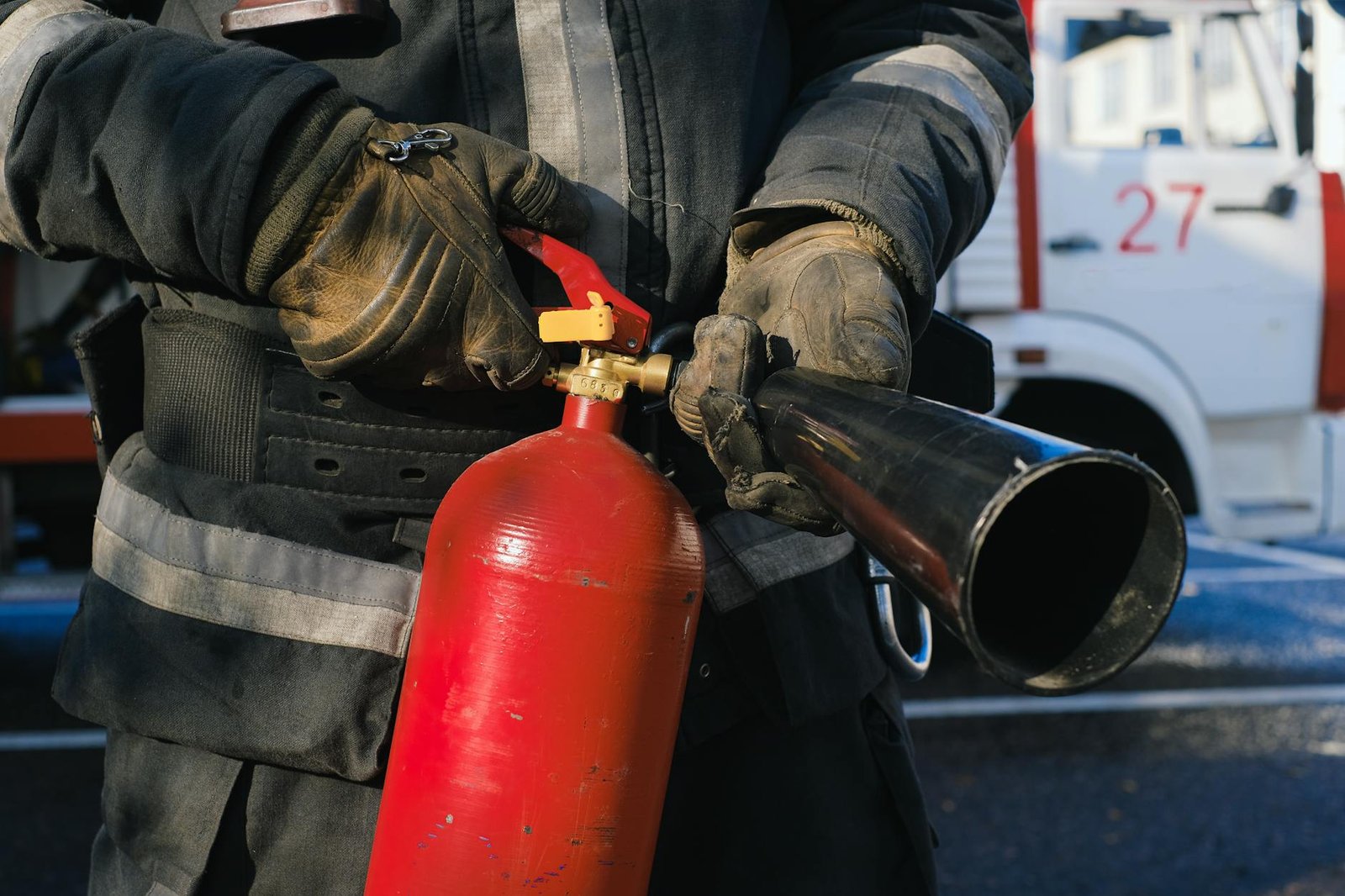
However, equipment is useless if the staff does not know how to operate it. Every fire safety training session conducted by our team emphasizes the PASS method. This is the global standard for operating portable fire extinguishers:
1. Pull: Pull the pin at the top of the extinguisher to break the tamper seal.
2. Aim: Aim the nozzle or hose at the base of the fire, not the flames themselves.
3. Squeeze: Squeeze the handle to release the extinguishing agent.
4. Sweep: Sweep the nozzle from side to side at the base of the fire until it appears to be extinguished.
In an industrial setting, such as a factory floor in an industrial estate, we recommend conducting quarterly mock drills where staff practice the PASS method using dummy extinguishers. This muscle memory is what prevents panic when a real fire breaks out. Remember, the goal of a portable fire extinguisher is to fight incipient-stage fires—those that are small and manageable. If a fire grows beyond the capability of the equipment, immediate evacuation must be the priority.
Comparison of Fire Extinguisher Types for Indian Facilities
Choosing the right type is just as important as choosing the right number. Below is a comparison of common extinguishers used across Indian commercial and industrial sectors.
| Extinguisher Type | Best For | Typical Price Range (INR) | Primary Standard |
| ABC Powder (Stored Pressure) | Multi-purpose (A, B, C fires) | ₹1,500 – ₹5,000 | IS 15683 |
| CO2 (Carbon Dioxide) | Electrical fires, Server rooms | ₹3,000 – ₹9,000 | IS 15683 |
| Water CO2 (Gas Cartridge) | Class A fires (Wood, Paper) | ₹2,500 – ₹6,000 | IS 15683 |
| Foam (AFFF) | Class B (Flammable liquids) | ₹2,000 – ₹5,500 | IS 15683 |
Note: Prices are estimates based on market rates for high-quality, IS-certified equipment. Bulk procurement for large facilities may attract lower unit costs.
The Role of Professional Maintenance and Inspection
Compliance is not a one-time setup; it is a continuous process. IS 2190 mandates regular inspections and maintenance. A fire extinguisher that has lost pressure or has a clogged nozzle is essentially a decorative object. In India, the humidity and dust levels in many industrial hubs can accelerate the degradation of equipment.
We recommend a three-tiered approach to maintenance:
1. Monthly Visual Inspection: Check for pressure gauge readings (should be in the green zone), ensure the pin is intact, and verify that the extinguisher is not obstructed.
2. Annual Service: This must be performed by a competent professional. It involves checking the weight of the agent, inspecting the hose and nozzle for cracks, and ensuring the cylinder is free of internal corrosion.
3. Hydrostatic Testing: Depending on the type of extinguisher, the cylinder must undergo a pressure test every few years to ensure it can withstand the stress of operation.
Neglecting these steps is the fastest way to invite liability. In the event of a fire, insurance companies will investigate whether your fire safety equipment was maintained according to the manufacturer’s instructions and Indian standards. If you cannot provide maintenance logs, your insurance claim may be denied, leaving your business to shoulder the entire financial burden of the recovery.
Challenges in Large-Scale Facility Management
Managing fire safety in large facilities, such as multi-story IT parks or expansive warehouses, presents unique logistical challenges. In these settings, you are not just counting extinguishers; you are designing a fire safety ecosystem. This includes smoke detectors, fire hydrant systems, and alarm systems that work in tandem with portable units.
When calculating the fire extinguisher count for a large facility, we utilize the concept of “Fire Load Density.” A warehouse filled with plastic components has a higher fire load than a warehouse storing metal parts. Therefore, the number of extinguishers required for the former will be significantly higher, even if the square footage is identical.
Furthermore, the layout of the facility matters. If your warehouse has long aisles, you must place extinguishers at the ends of these aisles and potentially at intervals along the length. We often see facilities that have enough extinguishers in total, but they are all clustered in the office area, leaving the high-risk storage zones unprotected. This is a critical failure in risk distribution.
FAQ: Frequently Asked Questions
Q: How often must I replace my fire extinguishers?
A: According to IS 15683 and IS 2190 guidelines, extinguishers do not have a fixed “expiry date” like food, but they do have a service life. With proper annual maintenance, a well-maintained cylinder can last for 10-15 years. However, if the cylinder shows signs of deep corrosion or fails a hydrostatic test, it must be replaced immediately.
Q: Can I use one type of extinguisher for my entire building?
A: While ABC powder extinguishers are versatile and cover most common fire types, they are not always the best choice. For example, in a server room, using a powder extinguisher can damage sensitive electronic equipment. CO2 extinguishers are preferred for electrical hazards as they leave no residue. You should assess your risk zones and use a mix of extinguishers as required.
Q: What is the minimum number of extinguishers for a small retail shop?
A: For a standard retail shop, NBC 2016 generally recommends at least two extinguishers (typically 4kg or 6kg ABC type) to cover the floor area, provided the travel distance requirements are met. However, you should consult with a fire safety professional to conduct a site-specific assessment based on the layout and goods stored.
Q: How do I know if my fire extinguisher is still pressurized?
A: Check the pressure gauge on the neck of the extinguisher. The needle should be in the green zone. If the needle is in the red zone (either under-pressurized or over-pressurized), the extinguisher is not reliable and needs immediate professional service.
Q: Are cheaper, non-IS marked extinguishers safe to buy?
A: No. We strongly advise against purchasing non-IS marked equipment. Fire safety equipment is a life-saving investment. Non-certified units often use inferior materials that may burst under pressure or fail to discharge when needed. Always insist on products that comply with IS 15683.
Q: Does the PASS method work for all fire types?
A: The PASS method is a universal technique for operating portable extinguishers. While the technique remains the same, your choice of agent depends on the fire class. Always ensure you are using the correct extinguisher type for the specific fire hazard you are facing.
Resources
For further reading on fire safety standards and compliance in India, please refer to the following official resources:
Conclusion
Fire safety is an investment in the continuity of your business and the protection of your most valuable asset: human life. Determining the correct number of fire extinguishers is the first step in building a robust defense against fire hazards. By adhering to the guidelines set forth in NBC 2016 and IS 15683, you not only ensure legal compliance but also provide your team with the tools necessary to act decisively during an emergency.
Since Safex established 1972, we have remained committed to the highest standards of fire safety engineering. We have seen firsthand how proper preparation, high-quality equipment, and regular training can turn a potentially disastrous incident into a minor, manageable event. Do not wait for a fire inspection to discover that your facility is under-protected. Conduct a comprehensive audit today, verify your coverage, and ensure your team is trained to use the equipment effectively. Your commitment to safety today is the foundation of your resilience tomorrow.